
When Should You Socialize a Puppy? Understanding the Critical Socialization Period
A puppy that happily explores the world today can become hesitant around strangers, noises, other dogs, or unfamiliar places later if those early experiences are missed or handled poorly. The puppy socialization window is one of the most important developmental periods in a dog's life. During these early weeks, puppies are especially receptive to learning that people, animals, sounds, surfaces, handling, and everyday environments can be safe.
But socialization is not about exposing your puppy to everything as quickly as possible. The goal is safe, gradual, positive exposure without overwhelming them. Understanding when this developmental window occurs and how to use it wisely can help build a confident, adaptable adult dog.
What Is the Puppy Socialization Window?
The puppy socialization window is an early developmental stage during which puppies are particularly receptive to forming associations with the world around them. Veterinary behavior guidance commonly describes the first three months of life as an especially important socialization period, with sources sometimes defining the sensitive period as approximately 3 to 14 weeks and others extending it toward 16 weeks.
During this stage, puppies are learning questions such as:
- Are unfamiliar people safe?
- Are other healthy dogs something to fear or enjoy?
- What happens when someone touches my paws or ears?
- Are cars, bicycles, children, vacuum cleaners, and doorbells dangerous?
- Can I relax in unfamiliar environments?
- What surfaces are safe to walk across?
These experiences can influence how a puppy responds to similar situations later in life. Socialization should continue throughout adolescence and adulthood, but early development deserves particular attention.
Why Is the Critical Socialization Period for Puppies So Important?
A puppy's brain is developing rapidly during the first few months of life. Positive experiences during the critical socialization period for puppies can help them learn that novelty does not automatically mean danger.
Insufficient or inappropriate socialization may contribute to problems such as:
- Fear of unfamiliar people
- Anxiety in new environments
- Sensitivity to noises
- Difficulty with veterinary handling
- Fear around other dogs
- Stress during grooming
- Hesitation on unfamiliar surfaces
- Defensive or avoidance behaviors
Behavior is complex, however. Genetics, prenatal influences, early maternal care, health, learning history, and later experiences also affect adult temperament. Socialization is therefore an important influence not a guarantee that a puppy will never develop fear or behavioral problems.
What Is the Best Puppy Socialization Age?
Many new owners ask, "When should I start socializing my puppy?" The simple answer is: appropriate socialization begins before most puppies even arrive in their permanent homes.
Breeders, foster caregivers, and rescue organizations can provide early positive exposure while puppies are still with their mother and littermates. Once a puppy moves into a new home, the owner can continue this process.
A Practical Puppy Socialization Timeline
Around 3–7 weeks:
Puppies begin becoming increasingly aware of their surroundings and learning from their mother, littermates, caregivers, surfaces, sounds, and gentle handling.
Around 8–12 weeks:
Many puppies move into their new homes during this period. Owners can carefully introduce household noises, different people, safe environments, handling, car rides, and controlled interactions.
Around 12–16 weeks:
Continue expanding positive experiences while paying close attention to the puppy's comfort and confidence.
After 16 weeks:
Socialization does not suddenly stop. Continue exposing the puppy to new situations gradually throughout adolescence and adulthood. The early window is important, but there is no single birthday after which a puppy becomes incapable of learning.
When Does the Puppy Socialization Window Close?
This question causes considerable confusion. The sensitive socialization period gradually changes as a puppy develops rather than closing like a door at one exact moment. Depending on the veterinary or behavioral source, the most sensitive period may be described as ending around 12–14 weeks or extending toward 16 weeks.
After this period, unfamiliar experiences may sometimes require more careful introduction and repetition. That is why owners should avoid unnecessarily postponing all safe socialization until several months of age. Early positive exposure matters, but quality matters more than simply checking off as many experiences as possible.
Socialization Is More Than Meeting Other Dogs
One of the biggest misconceptions about how to socialize a puppy is that socialization simply means letting the puppy play with other dogs. Dog-to-dog interaction is only one component. A well-designed socialization plan introduces a puppy gradually to many parts of everyday life.
1. Different Types of People
Where appropriate, puppies can have positive experiences around people with different appearances and movements,
including:
- Adults
- Children under close supervision
- Older adults
- People wearing hats
- People carrying bags
- People wearing glasses
- People using mobility aids
- People in uniforms
- People with facial hair
Never force a puppy to approach someone. Allow the puppy to observe from a comfortable distance and reward relaxed, curious behavior.
2. Everyday Sounds
Household and environmental noises can become frightening if a puppy has little experience with them. Introduce sounds gradually,
including:
- Vacuum cleaners
- Doorbells
- Kitchen appliances
- Traffic
- Thunder recordings
- Hair dryers
- Washing machines
- Construction sounds
- Children playing
Start at a low intensity whenever possible. If your puppy freezes, hides, repeatedly attempts to escape, refuses treats, or shows other signs of distress, increase the distance or reduce the intensity.
3. Different Surfaces
Walking across different textures can help puppies develop confidence and body awareness.
Safe surfaces may include:
- Carpet
- Tile
- Grass
- Concrete
- Rubber mats
- Gravel
- Wooden floors
- Safe stairs
- Metal veterinary scales
Do not drag or push a hesitant puppy onto a surface. Use treats, play, encouragement, and voluntary exploration instead.
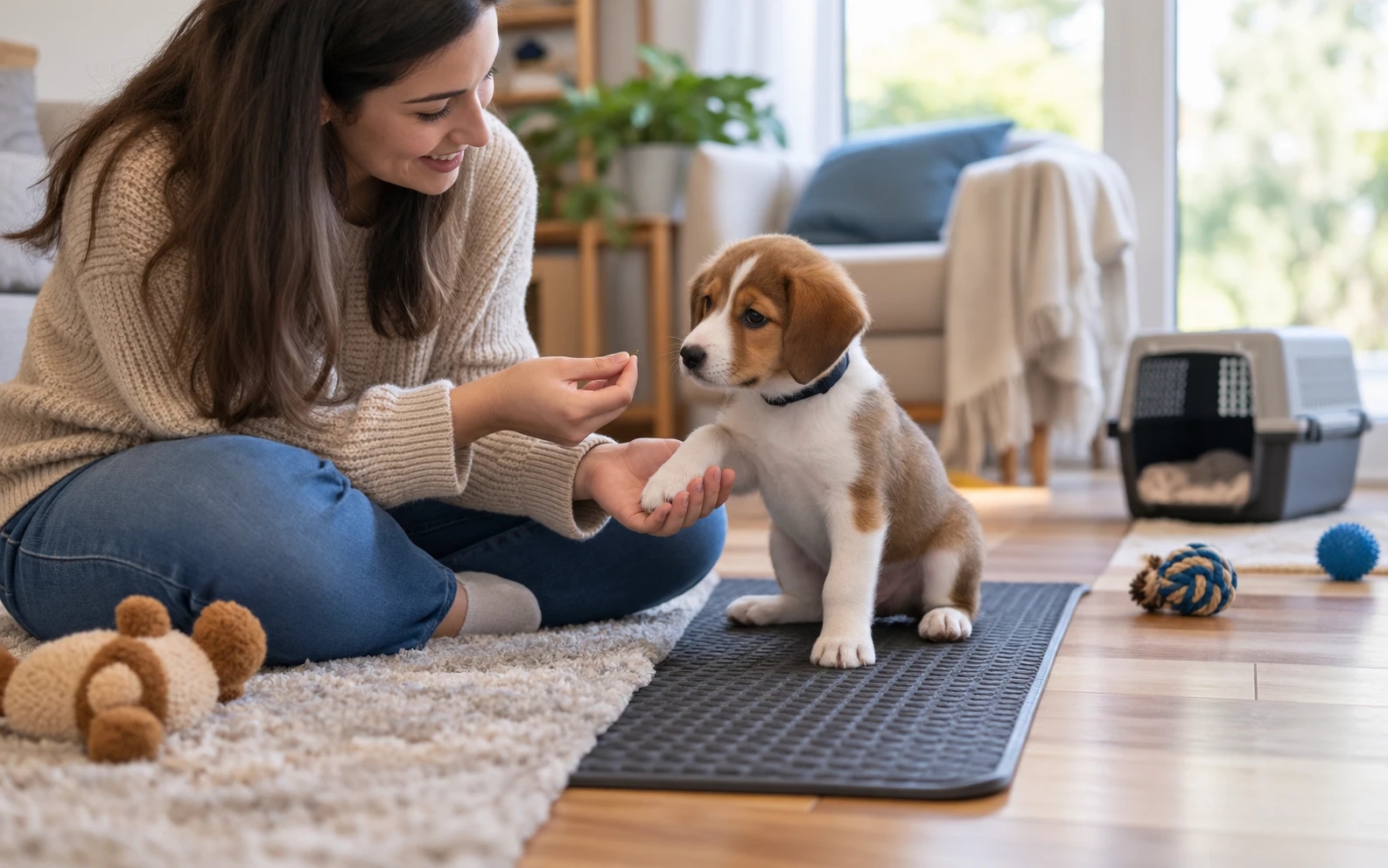
4. Gentle Handling
Handling exercises can prepare puppies for veterinary visits, grooming, and routine care.
Gradually introduce gentle touching of the:
- Paws
- Ears
- Mouth
- Tail
- Legs
- Chest
- Abdomen
Pair handling with something the puppy enjoys, such as a small treat. For example, briefly touch a paw, reward the puppy, and stop before the puppy becomes uncomfortable.
Can I Socialize My Puppy Before They Are Fully Vaccinated?
This is one of the most important questions for new puppy owners. Puppies need protection against infectious diseases, but completely isolating them during their early developmental period may also have behavioral consequences.
The goal is not to choose between disease prevention and social development. It is to balance both appropriately. Veterinary behavior guidance supports carefully managed early socialization before the complete puppy vaccination series is finished when appropriate precautions are taken.
However, infectious disease risk varies significantly by location and individual puppy.
Ask your veterinarian about local risks, your puppy's vaccination status, and which environments should be avoided.
Safer Ways to Socialize a Puppy Before Full Vaccination
Depending on veterinary advice and local disease risk, lower-risk experiences may include:
- Inviting healthy, vaccinated dogs you know into a controlled environment
- Carrying your puppy through public areas while allowing them to observe
- Taking short car rides
- Introducing visitors at home
- Practicing handling exercises
- Listening to everyday noises at controlled volumes
- Exploring a secure private yard where disease exposure is appropriately managed
- Attending a professionally managed puppy class that follows vaccination and sanitation requirements
Avoid assuming that every public dog area is appropriate for a young puppy. Places with high concentrations of unfamiliar dogs or potentially contaminated fecal material may carry greater infectious-disease exposure.
Should My Puppy Go to Puppy Socialization Classes?
A well-managed puppy class can provide structured opportunities for learning and controlled exposure. Good puppy classes are not simply uncontrolled play sessions.
Look for programs that emphasize:
- Positive reinforcement
- Controlled interactions
- Appropriate vaccination requirements
- Sanitation procedures
- Small, manageable groups
- Puppy body-language awareness
- Opportunities for puppies to disengage
- No forced interactions
- Reward-based training
Ask your veterinarian whether a particular class is appropriate based on your puppy's health and vaccination status.
Signs Your Puppy Is Comfortable During Socialization
Successful socialization should look relatively relaxed.
Positive signs may include:
- Loose body posture
- Voluntary exploration
- Taking treats normally
- Approaching and retreating freely
- Playful behavior
- Curiosity
- Recovering quickly after a mild surprise
- Choosing to interact
The puppy should have a choice whenever practical. Being physically present around something does not automatically make the experience positive.
Signs Your Puppy May Be Overwhelmed
Watch carefully for subtle stress signals.
These can include:
- Cowering
- Hiding
- Trembling
- Tail tucked tightly
- Persistent attempts to escape
- Freezing
- Refusing treats
- Excessive panting unrelated to heat
- Repeated lip licking or yawning in context
- Barking or lunging due to fear
If these behaviors appear, do not force the puppy to "get used to it." Create more distance, reduce the intensity, and give the puppy time to recover.
Common Puppy Socialization Mistakes
Forcing Interactions
Putting a frightened puppy directly into someone's arms or forcing them toward another dog can increase stress rather than confidence. Socialization should build positive associations, not simply exposure.
Trying to Do Too Much at Once
A crowded market containing children, dogs, traffic, music, carts, and unfamiliar people may be overwhelming for a young puppy. Break experiences into smaller, manageable sessions.
Assuming Fear Will Disappear on Its Own
Repeated fear deserves attention. If your puppy consistently reacts fearfully to everyday situations, talk with your veterinarian or a qualified reward-based behavior professional.
Using Dog Parks as a Primary Socialization Tool
Uncontrolled dog parks can expose young puppies to unpredictable dogs and potential infectious-disease risks. Controlled interactions with known, healthy, appropriately vaccinated dogs are often easier to manage.
Waiting Until Every Vaccination Is Complete
Disease prevention is essential, but complete isolation during the entire early socialization period may mean missing valuable opportunities. Work with your veterinarian to develop safe puppy socialization before vaccinations are fully completed rather than assuming the puppy must remain completely isolated.
What If I Missed the Puppy Socialization Window?
Do not assume it is too late. Older puppies and adult dogs can continue learning through carefully managed positive experiences. Progress may simply need to be slower, especially if the dog already shows fear.
Start with situations where your dog can remain comfortable. For example, instead of bringing a nervous adolescent puppy directly into a crowded shopping area, begin by watching people from a quiet distance while offering treats for calm behavior. Gradually decrease the distance as confidence improves. Never punish fear. Punishment may suppress warning signals without changing the underlying emotional response.
A Simple Puppy Socialization Checklist
Rather than trying to expose your puppy to hundreds of things, focus on positive, varied, repeatable experiences.
During the puppy socialization period, consider appropriate exposure to:
- Different people and appearances
- Calm, healthy dogs
- Household sounds
- Traffic sounds
- Car rides
- Veterinary environments
- Grooming tools
- Gentle body handling
- Different surfaces
- Appropriate stairs
- Bicycles
- Strollers
- Umbrellas
- People arriving at the door
- Being briefly alone
- Wearing a collar or harness
- Walking calmly on a leash
- New rooms and environments
Remember: a checklist is not a race. One calm, positive experience is often more useful than ten overwhelming ones.
How Long Should Puppy Socialization Sessions Last?
There is no universal number of minutes that works for every puppy. Young puppies can tire quickly, and learning often works best through short, positive experiences. Watch your puppy rather than the clock. End the session while the puppy is still comfortable instead of continuing until they become exhausted, frightened, or overstimulated.
The Bottom Line: Don't Waste the Puppy Socialization Window
The puppy socialization window is a valuable developmental opportunity, but it should not become a race against the calendar. Your goal is not to make your puppy meet every person, dog, noise, and environment before a particular birthday.
Your goal is to create repeated, safe, positive experiences that teach your puppy how to navigate the world with confidence. Start early, move at your puppy's pace, and balance behavioral development with appropriate disease prevention.
If you are unsure which experiences are safe for your puppy before the vaccination series is complete, talk with your veterinarian about creating an age-appropriate socialization plan. A little thoughtful guidance during these early weeks can help lay the foundation for a more confident and adaptable companion for years to come.